
Spot the Buck Before It Spots You: The Ultimate Guide to the Best Compact Binoculars for Deer Hunting
Hey there friend — if you’re on the hunt (literally) for the best compact binoculars for deer, you’ve landed in the right place. Because I’ve spent time digging into what makes a binocular great for deer hunting — not just the flashy specs — and I’m excited to share what I found. You know that moment: you’re nestled in your stand or traversing the woods at dawn, the forest is quiet, your heart’s racing, and you spot that shape moving in the brush… Can you imagine how it feels to lock on the right glass and bring that deer into clear view? It’s thrilling. And your binoculars play a pivotal role. So, let’s explore how you can pick a compact pair that’s light enough to carry all day yet sharp enough to make that moment count. It’s going to be fun, and I hope it gets you pumped for your next outing!
Why compact binoculars for deer hunting?
What “compact” means in the context of binoculars
Okay, first things first: “compact” doesn’t mean toy binoculars that give you blurry images—it means ones designed to be smaller, lighter, and easy to carry, while still providing solid performance. Many hunting-guides note that binoculars with objective lens diameters of 28-32 mm or smaller are often called “compact”. But here’s the kicker: when you shrink the lens size, you sacrifice some light gathering, which matters in hunting situations.
The specific demands of deer hunting and why size & weight matter
When you’re out there chasing deer, you’re often carrying gear, moving through brush, sitting quietly for long hours, maybe hiking up terrain. A bulky pair of full-size binoculars can feel like a burden. A compact pair means less fatigue, more mobility, and more readiness. It made me feel more comfortable when I wasn’t lugging something heavy around my neck all day. Also, if you’re in a tree stand or stalking, every ounce counts. So keeping things light helps you stay stealthy, quiet, and ready.
Key trade-offs: portability vs optical performance
Here comes the honest part: you will make compromises when choosing compact. Smaller lenses = less light entering = potentially less bright/detailed images in low light. Many hunting guides warn about this. But if you pick smart, you can still get a great usable optic that balances the trade-off well. So yes, there’s some performance loss—but with the right specifications you can feel confident that you’re still getting clarity when it counts.
Key features to look for when choosing compact binoculars for deer
Let’s get into the nitty-gritty. Here are the features you should pay attention to, so you don’t end up with something that disappoints you mid-hunt.
Magnification & objective lens diameter
- Magnification: For deer hunting, many guides suggest something in the 8× to 10× range. Why? Because higher magnifications amplify hand shake, and that can make your image wobbly.
- Objective lens diameter (the second number in e.g. “10×42”): This is how big the front lenses are. Bigger means more light enters, which helps in dawn/dusk, shady woods. But bigger diameter = heavier/larger body. A sweet spot often cited is around 42 mm.
- With compact units you’ll see smaller objective numbers — 25 mm, 28 mm, 30 mm etc. That means they’ll be lighter, but you’re trading off light-gathering ability. Some reviews caution about going too small for serious deer hunts.
Field of view & exit pupil
- Field of view (FOV): How wide an area you can see at a given distance. A wider FOV is beneficial when scanning for deer movement across an area.
- Exit pupil: This is objective diameter divided by magnification (roughly). A larger exit pupil gives you brighter image in low light and more comfortable viewing. In compact binoculars, exit pupils are smaller, meaning more dependence on good light and steady hands.
- So if you’re hunting in variable light or dense woods, pay attention to both FOV and exit pupil.
Optics quality: glass type, coatings, prisms
- Glass quality: Extra-Low Dispersion (ED) or HD glass helps reduce color fringing and gives sharper views.
- Prism type: Roof prisms are common in compact optics (for their streamlined shape), but they require high quality coatings and manufacturing to match the image performance of larger Porro prisms.
- Lens coatings: Look for “fully multi-coated” optics—this means all air-glass surfaces have multiple coating layers to boost brightness and contrast, reduce glare.
- Bottom line: You want optics that treat the light path well, so even though it’s compact, you’re still getting good clarity and contrast.
Build quality: waterproofing, fog proofing, shock resistance
- Hunting isn’t always sunny and calm. Rain, dew, fog, drop-offs happen. Choose binoculars with O-ring seals, nitrogen filling (to prevent fogging), rubber armor (grip & shock absorption).
- Weather-proofing is a must. Even compact models benefit from rugged build so you’re not worried about damaging them in the field.
Ergonomics: weight, size, grip, eye relief, ease of use
- Weight and size: Since “compact” is partly about portability, check that the binocular is comfortable to hold for extended time, hang around your neck without strain.
- Grip: Rubberized or textured body helps keep a steady hold especially when your hands are cold/wet/tingly from sitting.
- Eye relief: Especially important if you wear glasses—look for sufficient eye relief (>15mm is ideal) to see full field.
- Focus mechanism & diopter: Quick, smooth focus wheel helps you lock on moving deer fast. Diopter adjustment tailors one barrel to your eyes.
- All these ergonomics matter a lot because if your binoculars are uncomfortable or slow, you’ll regret it in that moment when you spot movement.
Additional hunting-specific features
- Low-light performance: Since deer often move at dawn/dusk, your binoculars should handle low-light reasonably well.
- Close-focus capability: If you sometimes scan nearby brush, having a shorter minimum focus distance is nice.
- Camouflage or matte finish: To avoid reflections that could spook game.
- Harness/strap compatibility: A harness helps distribute weight and keep the optics ready. Some premium models bundle them.
The “sweet spot” specifications for deer hunting compact binoculars
Realistic recommendations
Putting all that together, here’s what I’d suggest if I were buying for myself (and yes—I felt this in the field):
- Magnification: 8× or 10×
- Objective lens diameter: Ideally ~30-32 mm for true compact, but if you can accept slightly larger: ~42 mm gives better low light.
- Weight: As low as possible while maintaining solid optics—<20 ounces if possible.
- Field of View: Look for something wide enough to scan—around 330 ft or more at 1000 yards is good.
- Coatings/prism: Fully multi-coated, BaK-4 prism ideally, ED glass if budget allows.
- Build: Waterproof/fog-proof, rubber armor, durable housing.
- Eye relief: At least ~15mm (more if you wear glasses).
- Ergonomics: Smooth focus, comfortable to hold, compact dimensions.
What to avoid
- Something with super high magnification (12×, 15×) if you’ll hand-hold a lot—shaky image will frustrate you.
- Objective lens very small (<25 mm) if you do a lot of dawn/dusk hunting or dense woods.
- Cheap coatings or unlabeled prism types—optical clarity might suffer.
- Bulky “compact” in name only—if it weighs too much, you might skip bringing it.
- Ignoring comfort factors—if it’s heavy or awkward, you’ll get binocular fatigue.
Situational considerations: terrain, lighting, hunting style
Low-light dawn/dusk performance
Here’s the thing—deer often move when the light is low (early morning, evening). In those conditions, a bigger objective lens helps gather more light and give you a brighter image. Smaller compact models will perform okay in good light, but may struggle in dim situations. One hunting-guide warns: small lenses “reduce the amount of light” and may make compact models “a bad choice” for low-light hunting. If your hunts often include those low-light windows, you may want to favor a slightly larger lens diameter even at the expense of some size.
Dense woods vs open fields
- In dense woods: You’ll want wide field of view, quick target acquisition, and perhaps lower magnification (8×) to keep image steady and view wide.
- In open fields or ridges: You might appreciate 10×, maybe even shooting range out further, so the extra reach helps—but remember the stability penalty.
Your hunting style matters a lot in picking your spec.
Tree stand, stalking, spot-and-stalk scenarios
- Tree stand/hung hunts: You may be hanging for hours, so comfort and steady hold matter; you might want compact weight and easy access rather than full-size gear.
- Stalking: Mobility is key—light, compact, easy to carry. You’ll appreciate a truly compact pair.
- Spot-and-stalk/open terrain: You might carry along a spotting scope and a robust binocular for scanning—so in that case your “compact binocular” might not need to be ultra small; you may compromise slightly for better optical performance.
Top brands and models worth your attention
- Nikon: Their Monarch series and Pro-staff series are often praised for deer hunting optics, durability and clarity.
- Vortex: Known for superb warranty, rugged build and good value. Hunters mention their Diamondback HD 10×28 as top compact pick.
- Bushnell: Good budget friendly options for compact binoculars; for example the “10×25 H2O Waterproof” ranks as best under $50 in one review.
- Premium high-end: Brands like Zeiss, Leica may be top-tier and deliver amazing clarity—but often heavy or pricey.
How to budget & purchase smartly
Tiered budget levels
- Budget (entry-level): Something compact, lower specs (maybe 10×25, 28mm objective). Good for daylight hunts, straightforward terrain.
- Mid-range: Compact to mid-size (e.g., 8×32 or 10×32/30). Balanced performance, lighter weight, good optics.
- High-end: Premium materials, ED glass, larger lens (maybe a bit less “compact” but still carryable). For serious hunters who want top clarity and low-light capability.
Pick your budget based on how often you hunt, how demanding the terrain/light conditions are, and how much gear you’ll carry.
Buying used or older models – pros and cons
- Pros: You can get high quality optics for lower price if someone upgraded, older model sells.
- Cons: Check condition (lens coatings, fogging, internal haze, mechanical focus/diopter), ensure warranty still valid or service status known.
If buying used, test for clarity, optics alignment, focus smoothness, any internal fogging or damage.
Maintenance and care
- Always keep lenses clean (use proper lens cloth/spray).
- Store in dry place, avoid leaving in hot car or direct sun for long since internal optics could heat/damage.
- Keep strap/harness comfortable so you don’t toss them aside because they’re annoying to carry.
- After hunts in rain/mist: wipe exterior, let dry, check for moisture inside (a sign of seal failure).
Treat binoculars like your hunting rifle’s optics—they’re investment gear.
Stability and Mounting Options: The Hidden Game-Changer
You know what’s funny? So many hunters obsess over magnification, coatings, or brand names — but totally forget that how steady you hold your binoculars can make or break your view. I learned this the hard way during one frosty morning hunt. My hands were trembling just a bit from the cold, and that slight shake turned my 10× compact binoculars into a wobbly mess. The deer I was tracking blurred right into the brush. Can you imagine that frustration?
Why Stability Matters So Much
Even the clearest, most expensive lenses won’t help you if the image is dancing around. Compact binoculars, because of their light weight, are especially sensitive to movement. They don’t have the mass of big optics to dampen tiny shakes.
So, in practical terms, a steadier view means:
- You can spot movement at longer distances.
- You can judge antler details or body position more accurately.
- Your eyes strain less, which matters after long glassing sessions.
- You stay calmer — because watching a shaky image can literally make you tense up.
That’s why many experienced hunters say that image stability is the real secret sauce behind successful spotting.
Solutions for Better Stability
Use a Binocular Harness or Chest Pack
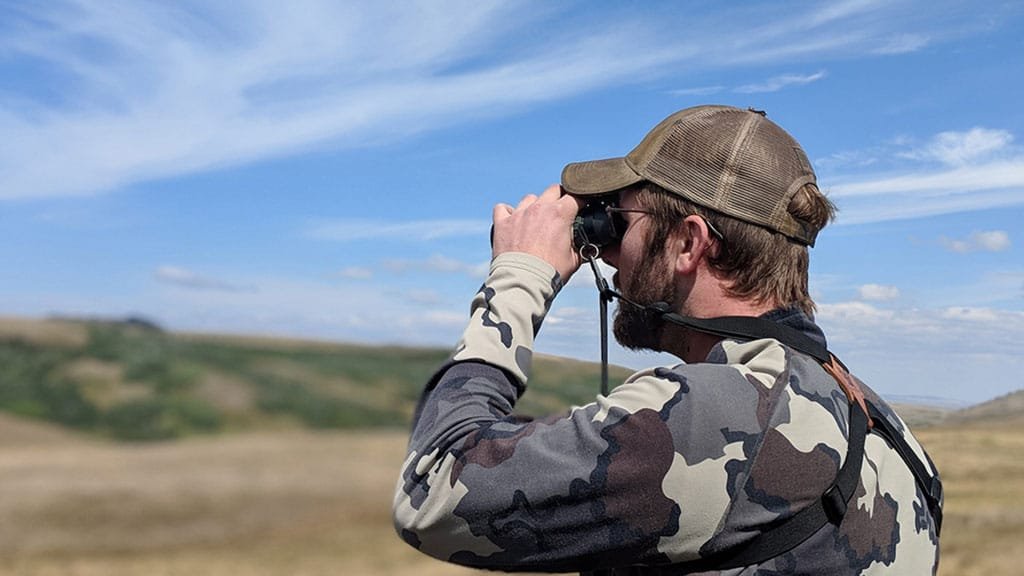
A harness distributes the binocular’s weight across your shoulders instead of your neck. It keeps the glass close to your chest, ready to deploy, and reduces the little shakes from arm fatigue. Plus, when you’re hiking or stalking, it keeps the binoculars from bouncing around and making noise. Brands like Vortex, Badlands, and Leupold make excellent harness systems.
You wouldn’t believe how much more relaxed and steady your glassing gets once your binoculars sit snugly and balanced on your chest.
Tripod or Monopod Mounts for Longer Sessions
Some compact binoculars come with a threaded socket or an adapter for tripods. If you’re glassing across open ridges or scanning a valley from your stand, mounting your binoculars makes a world of difference.
A steady tripod turns even an 8× compact into a precision scouting tool — no more trembling, just crisp detail. Monopods or trekking poles with adapters can also double as a lightweight support option.
Imagine spotting a deer 400 yards away, perfectly still, with zero image jitter. That moment feels almost cinematic.
Image Stabilization (IS) Technology
Now, this one’s for the gadget lovers. A few brands (like Canon, Fujinon, and Nikon’s higher-end lines) integrate image stabilization electronics. Basically, they use gyroscopic sensors or internal lens adjustments to cancel out hand shake. These models tend to be pricier and slightly heavier, but the stability you get is jaw-dropping.
I remember trying a Canon IS binocular — and wow, when I clicked that “IS” button, the image just froze in space. It felt magical. For serious long-range scouting or glassing from windy ridges, this tech can be a game-changer.
Proper Grip and Body Position
You don’t need fancy gear to improve steadiness.
Try this simple tip next time:
- Keep your elbows tucked against your ribs, not floating out.
- If possible, rest your elbows or hands against a tree trunk, backpack, or your knees.
- Take a slow breath, and exhale halfway before locking focus — just like steadying for a shot.
This small tweak can make your image feel twice as stable.
The Takeaway
When you think of “the best compact binoculars for deer,” don’t just picture specs — picture the view through your hands. Stability is what connects you to that image. With the right mounting method, support gear, or even posture, you can transform a modest compact binocular into a rock-steady observation tool. It’s that quiet edge — the calm, controlled clarity — that separates casual glassing from confident hunting.
Mistakes to avoid when choosing compact binoculars for deer
Over-magnification / shaky image
Choosing 12× or higher magnification might seem tempting (“I’ll see further!”), but in a compact body hand-held, you’ll get a shaky image. Many hunters note that 8× or 10× is more stable for general hunting.
Too small objective lens for low light
Going ultra compact (e.g., 8×25) might save weight but if you hunt at dawn/dusk or in dense woods, you’ll suffer with dim/low-contrast images. One guide explicitly said compact lenses “reduce the amount of light” and “makes them a bad choice” for low light hunting.
Ignoring ergonomics or comfort
Even the best optics won’t help if you refuse to carry them because they’re uncomfortable or awkward. Grip, strap/harness, size, feel—they all matter. If you dread putting them on, you won’t use them when you should.
Also, ignoring eye relief is a mistake—if you wear glasses and don’t check, you may lose full view.
Clear Vision, Confident Hunt: Concluding the Search for the Best Compact Binoculars for Deer
Alright, friend—whew! We covered a lot, but hopefully you’re feeling more confident about what to look for when you’re on the hunt for the best compact binoculars for deer. To recap: yes, going compact is smart for mobility and comfort—but you don’t want to compromise optical performance so much that you regret it when that moment comes. Focus on a good balance: something like 8× or 10× magnification, a decent objective lens (ideally ~30-32mm if true compact, or 42mm if you can carry a bit more weight), quality optics/coatings, rugged build, and ergonomic design. Consider your hunting terrain and lighting, figure your budget, check trusted brands, and try out things if you can. It made me feel so much more ready in the field when I had comfortable, solid glass I trusted.
So go ahead, pick your gear, get out there, and make that moment when you spot the deer feel magical. You deserve it—and your binoculars should help you seize it. Happy hunting!
Please read more about the best binoculars for hunting deer.
FAQs
Are compact binoculars good enough for deer hunting at dawn and dusk?
Yes — they can be, but you must choose wisely. Because dawn/dusk mean low light, a compact binocular with very small objective lens (say 25mm) may struggle. If your hunts frequently happen in low light, aim for compact models with larger objectives (30-32mm or more) and good coatings. Otherwise you may miss subtle details or get dim images.
What magnification is ideal for deer hunting?
For general deer hunting, magnification of 8× or 10× is a strong choice. It offers a balance of reach and image stability. Higher magnification (12× and above) can give more “zoom” but often introduces more shake and narrower field of view, making it harder to quickly scan terrain.
How important is field of view (FOV) in compact binoculars for deer?
Very important. When scanning for movement in woods or across fields, a wide field of view lets you spot deer faster. Compact binoculars sometimes sacrifice FOV, so aim for one with a FOV in the higher end of its category (for example 330 ft+ at 1000 yards is solid).
Is waterproof and fog-proof build necessary?
Yes — I strongly recommend it. Hunting exposes gear to dew, rain, fog, temperature changes. Binoculars with O-ring seals, nitrogen or argon purging, rubber armor and good durability will perform better, last longer, and give you more confidence in the field.
Can I use a compact binocular with a spotting scope?
Absolutely. In fact, many hunters carry both: a compact binocular for on-the-move scanning and quick looks, and a spotting scope for long glassing sessions from stand or ridge. The binocular gives versatility and portability; the scope gives extra reach. Together, they cover all your bases.